A homeowner’s boiler upgrade guide
High-Efficiency Boilers: What to Know Before Upgrading
A modern boiler can reduce fuel use, improve comfort, and lower heating costs—but the equipment is only as good as the system it serves and the way it is installed.
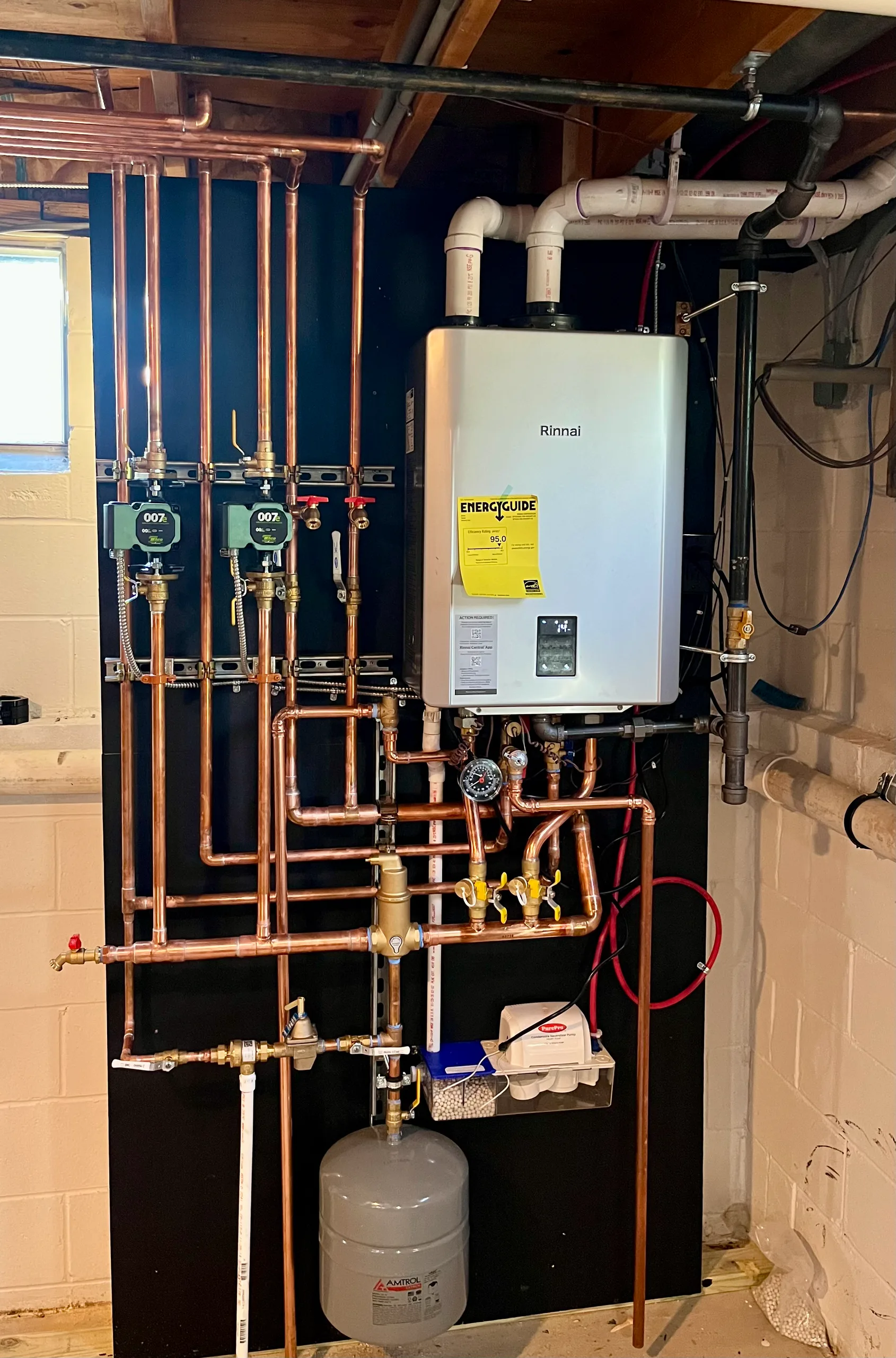
Start with the whole system
Replacing the boiler is only part of the upgrade.
The boiler, radiation, piping, pumps, controls, venting, and installation all work together. Choosing efficient equipment matters, but matching and commissioning the complete system is what allows that equipment to perform.
What “high efficiency” means
Condensing boilers recover heat that older designs send up the chimney.
Traditional boilers keep their exhaust hot enough to protect cast-iron sections and masonry chimneys from condensation. That design is durable, but a meaningful amount of usable heat leaves with the flue gases.
A high-efficiency condensing boiler cools the exhaust further and captures additional heat. As water vapor in the flue gas condenses, the boiler transfers more energy into the heating water. The equipment and venting are built to handle and safely drain that condensate.
THE KEY PRINCIPLE
Cooler return water creates more opportunity for the boiler to condense—and therefore operate at higher efficiency.
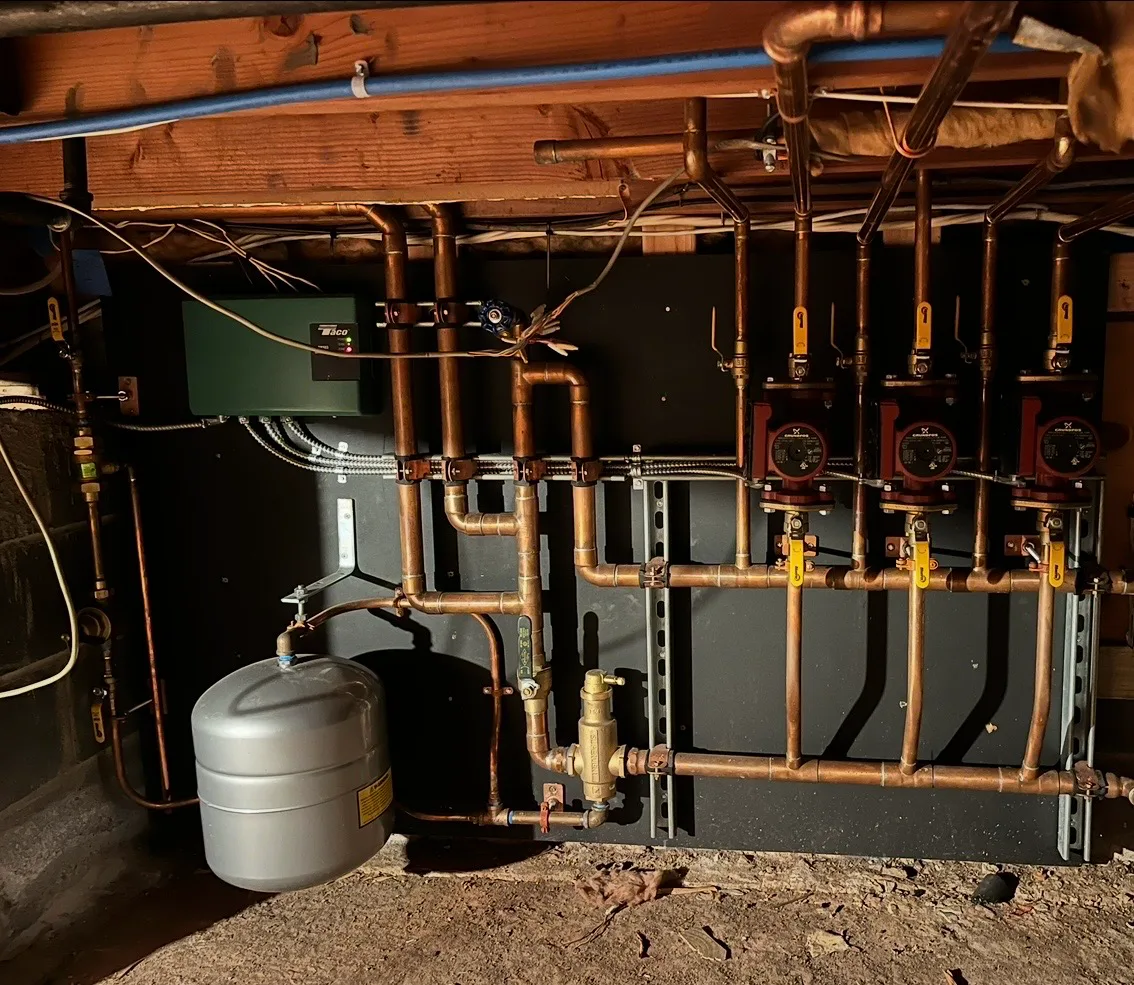
Lower water temperature, higher efficiency
The boiler should respond to the weather outside.
Older systems were commonly designed around high water temperatures for the coldest expected day of the year. Most winter days are not design days, so the system often does not need water that hot.
An outdoor sensor allows the control to use an outdoor-reset curve. On milder days, the boiler supplies cooler water, runs longer and steadier, and has more opportunity to condense. As outdoor temperature falls, the control raises the supply temperature to meet the home’s heating load.
01 / MILD DAY
Cooler supply water
Lower-temperature operation gives the boiler its best chance to condense and approach peak efficiency.
02 / COLD DAY
Warmer supply water
The reset control increases water temperature as the home needs more heat, balancing comfort and efficiency.
03 / DESIGN DAY
Full design output
The boiler may run hotter to cover the peak load, so efficiency can be lower than the unit’s best-case rating.
Think seasonal savings, not a fixed daily percentage.
A boiler rated in the mid-90-percent range does not operate at that number under every condition. The real benefit comes from reducing energy use across the entire heating season through proper sizing, lower water temperatures when possible, and well-tuned controls.
High efficiency vs. conventional
Two proven approaches, with different tradeoffs.
Actual performance, maintenance needs, and service life depend on the equipment, application, water quality, controls, and installation.
MODERN + RESPONSIVE
High-efficiency condensing
- Efficiency: commonly 90%+ AFUE, with peak ratings in the mid-to-high 90s under favorable operating conditions
- Comfort: steadier temperatures, longer run times, and more precise zoning potential
- Installation: requires compatible venting, condensate drainage, controls, and careful commissioning
- Service: advanced components call for regular maintenance and qualified diagnostics
- Space: compact wall-hung options can free up mechanical-room floor area
SIMPLE + FAMILIAR
Conventional non-condensing
- Efficiency: many current systems operate around the low-to-mid 80% range; older equipment may be significantly lower
- Comfort: typically less precise modulation, with a greater chance of temperature swings or short cycling
- Installation: may fit some existing high-temperature systems and chimney arrangements more simply
- Service: fewer advanced components and familiar repair practices
- Longevity: robust construction can provide a long service life when properly installed and maintained
Which boiler should you choose?
The right answer depends on your home and your priorities.
A conventional boiler can still make sense when simplicity, familiar construction, and compatibility with an existing high-temperature system matter most.
If you want smarter control, improved seasonal efficiency, steadier comfort, or a compact wall-hung system that opens up floor space, a high-efficiency boiler may be the better investment.
Before deciding, have the home’s heat loss, radiation capacity, venting route, fuel supply, condensate path, zoning, and domestic hot-water needs reviewed. That assessment matters more than choosing the highest number on a yellow label.
Ask for these checks
- A room-by-room or whole-home heat-loss calculation
- Review of radiators, baseboard, or radiant zones
- A water-temperature and outdoor-reset strategy
- Venting and condensate-drainage planning
- Clear maintenance and service expectations
Plan the whole upgrade
Let’s find the right boiler for your home.
Steam Punk Plumbing & Heating can review your existing system, explain the options, and plan an installation around comfort, efficiency, and long-term serviceability.